
Beyond the Backpack
Developing a backpack concept to address unmet college student's needs
User Testing,
Rapid Prototyping
15 weeks
(Sept 2023 - Dec 2023)

Skills
Concept Development,
Design Research,
Timeline
Overview
The goal of the project is to generate a better understanding of this problem space (undergraduate students at Carnegie Mellon that use a backpack / bag) and create concepts and low fidelity prototypes to address key user pain points.
How might we design a better way for undergraduate students to transport their items between their home and work / campus?
Phase 01: Remine
Understand the existing space
Market research
Looking into some of the trends and forecasts in the industry gave me a better understanding of the design space and where it was projected to expand into in the future.

Source: Fortune Business Insights; Statista (survey conducted 2022, published May 2023)

Source: IBISWorld (published March 2023)
Looking at the market segmentation, backpacks still hold the majority of the market share, and ultimately the value of the market is projected to continue to increase for at least the next decade. However, demand for outdoor packs (e.g. for hiking purposes) has increased recently - especially around the time of the pandemic - and is expected to occupy a larger portion of the market in future years. Therefore I see a potential opportunity to create a hybrid product that merges the best features of a backpack and outdoor pack to create a 2-in-1 bag that people can purchase for multiple purposes instead of having to buy two separate bags.
Design history
I think it's important to first understand where the backpack design came from / what has been done before to be better informed on developing concepts for where the backpack could go in the future.
Children bring bacpacks to school (previously book straps or carrying)
1940s

Caribou Cricket - backpack designed with university students in mind. Rectangular and made to transport books.
1975

L.L.Bean Book Pack - bookbag that became really popular with students in the East Coast (e.g. at Harvard)
1982
1938
First zippered backpack

1967
JanSport's original frame pack comes out
1978
First Fjällräven Kånken backpack produced

1984
JanSport Spring Break - designed for textbooks. Became popular in the West Coast
Competitor benchmarking
Looking at existing backpacks that are popular gave me an insight into the features current consumers value, and the choices that should be preserved in future iterations.
Fjällräven Kånken Laptop
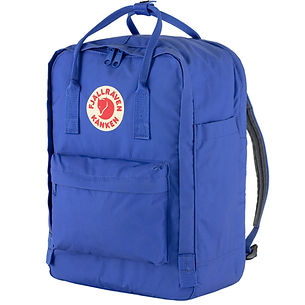
Pros
Compact and lightweight
Accessible laptop compartment
Comfortable / ergonomic
Cons
Expensive
Material fades over time
Side pockets are too small to use
Phase 02: Define
Who are we designing for? What are their needs, desires, and pain points?
User survey (30 students)
Goal: understand how students view and use their backpacks
Sent via Google Forms, the survey asked questions about: the pros and cons of students' current backpacks; feature prioritization; how often they use their backpack and for what; and the budget and purchasing decisions behind buying their current backpack.
User interviews (3 students)
Goal: develop more specific insights and a deeper understanding of backpack selection
These in-person interviews focused more specifically on the backpack of the individual and understanding where they pack which items. I also did a feature prioritization exercise with them to rank what they care most about in their backpack, and highlight where the pain points are.
Key Insights
Features ranked
-
Multi-purpose (versatile) design
-
Size
-
Has specialized compartments (e.g. padded laptop compartment)
-
Made from weatherproof materials
-
Straps are padded
Average budget: $72-$83


What's working well
-
Laptop compartment
-
Everyone surveyed and interviewed was happy with the level of padding in this compartment.
-
-
Durability
-
Most of the students surveyed bought their backpack at the start of college with the intention of it lasting >4 years.
-
-
Brand trust
-
Some students mentioned specific brands that they were exclusively focused on when looking for their backpack.
-
-
Size and capacity
-
Lightweight
-
Good material choice used to construct backpack.
-
-
Weather-specific features
-
Umbrella pouch, water-resistant materials.
-
Pain points
-
Inconvenient front pocket
-
Too small, and often students don't have the most use for all the smaller sewn in pockets. Additionally, when the main compartment fills up it can eat into the space available in this pocket.
-
-
Unstructured main compartment
-
Objects placed in this area tend to slide around. Some students noted that this compartment felt flimsy.
-
-
Uncomfortable shoulder straps
-
This feature was consistently ranked the lowest, but when this isn't being met it becomes a very large pain point (just not one that students seem to prioritize till it becomes a concern).
-
-
Insufficiently sized side pockets
-
Too bulky & straps too long
-
Especially for students with a smaller-frame.
-
Phase 03: Develop
Rapid prototyping
Brainstorm & concept selection
Using the key insights gathered in the previous phase I brainstorm several concepts.


I selected 3 ideas to move forward to the prototyping stage with. Each idea targets a different pain point and section of the backpack:
1. Shortened shoulder straps
Allows you to hide excess shoulder strap length
2. Elastic side pocket
Taller and wider pocket with an adjustable strap over it to
secure items like water bottles
3. Detachable bottom compartment
Increases versatility of the backpack by creating extra
capacity to carry other items
Prototype 1: Shortened shoulder straps


This prototype addresses a pain point for smaller-framed individuals who have to shorten the length of the shoulder straps significantly to get the backpack to fit them at an appropriate height. This creates extra unused strap length that is left to dangle. While this is not a major inconvenience, it is mildly annoying to have it repeatedly swinging against your leg or when travelling with a suitcase potentially dragging on the floor or getting caught up in the wheels of your suitcase.
Using a velcro attachment point, this prototype is a quick and simply way to hide the excess strap length.
Prototype 2: Elastic side pocket


This prototype addressed a frequently expressed frustration with the side pockets on student's backpacks. Often the pockets aren't large enough to fit items like a water bottle, and when they are adequate in size they often don't grip / keep the bottle in place. Some students noted that they stopped using these pockets entirely because when they bend over or crouch down the bottle falls out of the pocket.
The design consists of a tall elastic mesh pocket that can expand to accomodate larger diameter waterbottles, and keep them tightly in place. I also added a strap with velcro to give at an extra degree of safety.
This was the trickiest prototype to make as it needed to be a higher fidelity than the others in order to be user-testable to the same degree. I really struggled with the thickness of the material (it was very hard to sew thick elastic, and a lot of my safety pins would bend when I tried to use them to attach the pocket to the backpack).
Prototype 3: Detachable bottom compartment

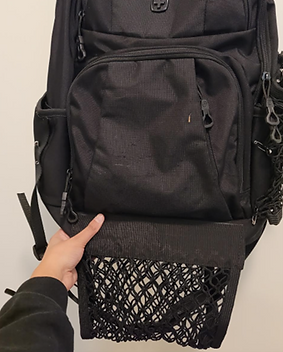


I decided to use an adjustable strap and buckle system to join the compartment to the main backpack because it is an intuitive component that most are already familiar with, and creates some modularity allowing for potentially different sized compartments to be added depending on the size requirements / use case. Initially I created one loop that was only attached to the backpack and went around the compartment. This proved to be very unstable and the compartment would constantly slip out even when trying to wear the backpack. I thought about trying to utilize the elastic mesh used in Prototype 2, but ultimately decided that this would be more difficult to use than the buckle.
In the tested version of this prototype, I decided to use two buckles to connect opposite sides of the compartment to the backpack. While it is certainly more stable than the first attempt, it still does wobble - especially as you walk. I think the next version of this will need to have the compartment being connected to the backpack on all 4 sides.
Phase 04: Test
Evaluate and refine prototypes
Prototype 1: Shortened shoulder straps
Key Insights
-
Is a positive change, but not a big change
-
The dangling straps are a bit inconvenient, but not super noticeable. They become more annoying when they drag on the floor as the suitcase is being pulled so definitely more of a use case for them in a travel context
-
-
The pulling up motion to attach the straps to the Velcro is nice and intuitive
-
Would be great if the strap length was adjustable with this motion as well instead of having to pull down.
-
-
(The padding on the shoulders is nice but should cover more of the shoulder and back area.)


Prototype 3: Detachable bottom compartment
Key Insights
-
Integrated compartment is better than having to bring another bag.
-
Placement is good. Preference is to have a slim and long backpack than a short and bulky one.
-
Extra height added to the backpack is fine because it is removable (would not like if it was a permanent compartment).
-
Placing it elsewhere would make the backpack too bulky.
-
Making the backpack itself shorter and placing the removable component higher would make it feel weird to use the backpack without the compartment.
-
-
Needs to have more straps connecting it / something to stop it from moving around so much.


Prototype 2: Elastic side pocket
Key Insights
-
The tall height makes this very secure and better than the existing side pocket.
-
However, the height makes it harder to insert the bottle (must remove a strap and rotate the backpack to access it more easily).
-
Has more stretch than some of the existing mesh pockets so can accommodate the bottle with no issues.
-
The Velcro strap is unnecessary – the elastic by itself works so well to keep the object snug even when you’re bending over.

